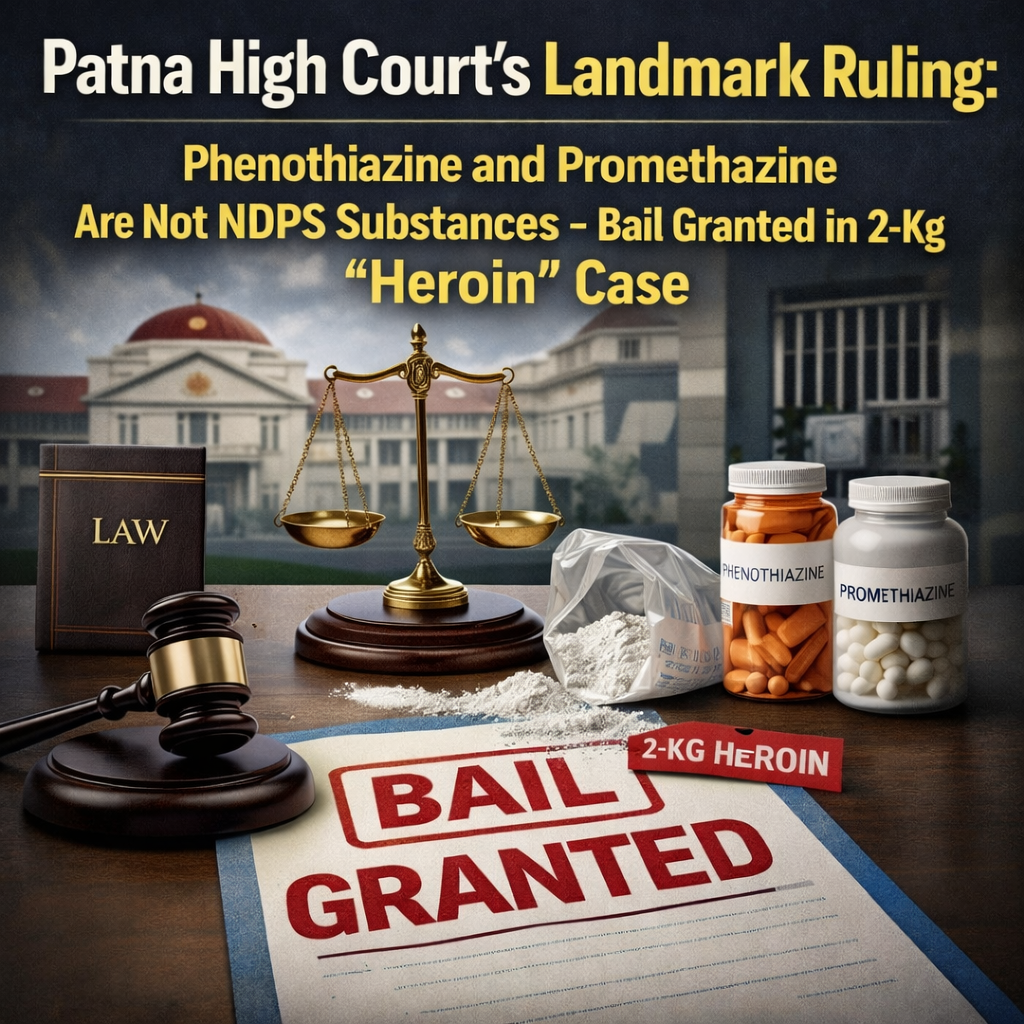
Court ruled that the seized substances identified by the Forensic Science Laboratory as Phenothiazine and Promethazine do not qualify as narcotic drugs or psychotropic substances under the NDPS Act, 1985.
This ruling draws a clear line between regulated medicines and prohibited narcotics, highlighting the importance of precise chemical classification in drug related prosecutions.
The Case at a Glance
The incident dates back to June 26, 2022 in Bodh Gaya, Bihar. Acting on a tip off police intercepted three individuals Vijay Kumar, Dharmendra Kumar, and Ravindra Kumar riding motorcycles near a hotel on National Highway 83. A search conducted in the presence of a magistrate led to the recovery of more than 2 kg of a white powder suspected to be heroin, along with mobile phones and the vehicles.
The trio was booked under Sections 8, 21(c),25 and 29 of the NDPS Act. After trial, they were convicted and sentenced to 15 years of rigorous imprisonment plus a fine of ₹1.5 lakh each by the Special NDPS Court in Gaya on January 8, 2025. The accused appealed to the Patna High Court, arguing that the Forensic Science Laboratory (FSL) report did not confirm heroin at all. Instead, it identified the substances as Phenothiazine along with Promethazine common pharmaceutical ingredients not listed under the NDPS Act.
What Are Phenothiazine and Promethazine?
Phenothiazine and Promethazine are well known pharmaceutical compounds with legitimate medical uses:
- Promethazine is widely used as an antihistamine, antiemetic (to prevent nausea and vomiting), and sedative. It is commonly found in cough syrups, allergy medications and motion sickness tablets.
- Phenothiazine belongs to a class of antipsychotic and antihistaminic drugs. It has been used in treating mental health conditions and as a precursor in the synthesis of several medicines.
Both substances are explicitly listed in Schedule H and Schedule G of the Drugs and Cosmetics Rules, 1945, under the Drugs and Cosmetics Act, 1940. This means they are prescription drugs regulated for quality, sale, and distribution but they are not scheduled as narcotic or psychotropic substances under the NDPS Act or any Central Government notification.
Court’s Reasoning: A Clear Legal Distinction
A Division Bench comprising Justice Mohit Kumar Shah and Justice Arun Kumar Jha heard the appeals (Criminal Appeal (DB) Nos. 285, 291 and 657 of 2025). After carefully examining the FSL report and statutory provisions, the court observed that the recovered substances do not fall within the definition of “narcotic drug” or “psychotropic substance” as per the NDPS Act.
The bench noted that while these compounds may sometimes be used as “cutting agents” to dilute street drugs, their mere presence does not automatically attract NDPS provisions unless they are explicitly notified. The court emphasized that violations involving scheduled drugs under the Drugs and Cosmetics Act are punishable under that specific law typically through complaints filed by authorized Drug Inspectors, not police FIRs under NDPS.
In its order, court stated that the conviction under NDPS appeared “prima facie unsustainable.” Consequently, it suspended the 15 year sentence and directed the release of the appellants on bail during the pendency of their appeals. Each was required to furnish a bail bond of ₹10,000 with two sureties of the same amount.
Why This Ruling Matters
This decision is more than just a bail order it carries broader implications for:
- Law Enforcement and Prosecution: Police and investigating agencies must ensure accurate chemical analysis before invoking the harsh provisions of the NDPS Act, which carries a reverse burden of proof and stringent bail conditions.
- Pharmaceutical Industry: Legitimate manufacturers, distributors, and pharmacies dealing in these compounds can breathe easier, knowing that simple possession or transportation (when properly documented) will not trigger NDPS cases.
- Judicial Precedent: The ruling reinforces that NDPS prosecutions must strictly adhere to the scheduled list. Similar compounds mistaken for narcotics in the past have led to prolonged trials and wrongful convictions this judgment may help prevent such miscarriages of justice.
- Public Awareness: It underscores the difference between regulated medicines and illicit drugs, potentially reducing unnecessary fear around common pharmaceutical products.
The state had argued for a broader interpretation to curb drug trafficking, but the court prioritized statutory interpretation over policy concerns, a reminder that the rule of law must prevail over expediency.
What Happens Next?
The appellants remain out on bail while their main appeals are pending before the Patna High Court. The final outcome will depend on a detailed examination of evidence, including chain of custody and compliance with NDPS procedural safeguards. For now, this order serves as an important checkpoint in Indian jurisprudence on drug classification.
Key Takeaways for Readers
- Always verify the exact chemical composition in drug cases assumptions can lead to wrongful prosecutions.
- Phenothiazine and Promethazine are legitimate medicines, not banned narcotics.
- NDPS cases require strict adherence to the Act’s schedules; the Drugs and Cosmetics Act handles pharmaceutical violations separately.
- This ruling protects genuine medical compounds while maintaining the fight against real drug trafficking.
The Patna High Court has once again demonstrated its commitment to upholding precise legal standards in an area where emotions and public pressure often run high. As India continues its battle against narcotics, judgments like this ensure that the law remains fair, evidence based and proportionate.
Have you come across similar cases where pharmaceutical drugs were mistaken for narcotics? Share your thoughts in the comments below. For more updates on important legal and health related judgments in India, subscribe to our newsletter and follow us on social media.
Disclaimer: This blog post is for informational purposes only and does not constitute legal advice. Readers are advised to consult qualified legal professionals for specific cases.