The latest update on MBBS intern stipend disparity in India (April 2026). Union Health Ministry clarifies the issue falls under NMC domain with no further action from the government. Read about current stipend ranges, Supreme Court updates student impact and what aspiring doctors should do.
Every year over 1.5 lakh MBBS students across India complete their undergraduate degree and step into the compulsory one year rotating internship. For most, this is their first taste of real clinical responsibility and their first paycheck as a doctor but here’s the harsh reality: not all interns are paid equally. While some earn ₹25,000–₹32,000 per month others receive as little as ₹5,000 or even nothing at alldespite performing the exact same duties.
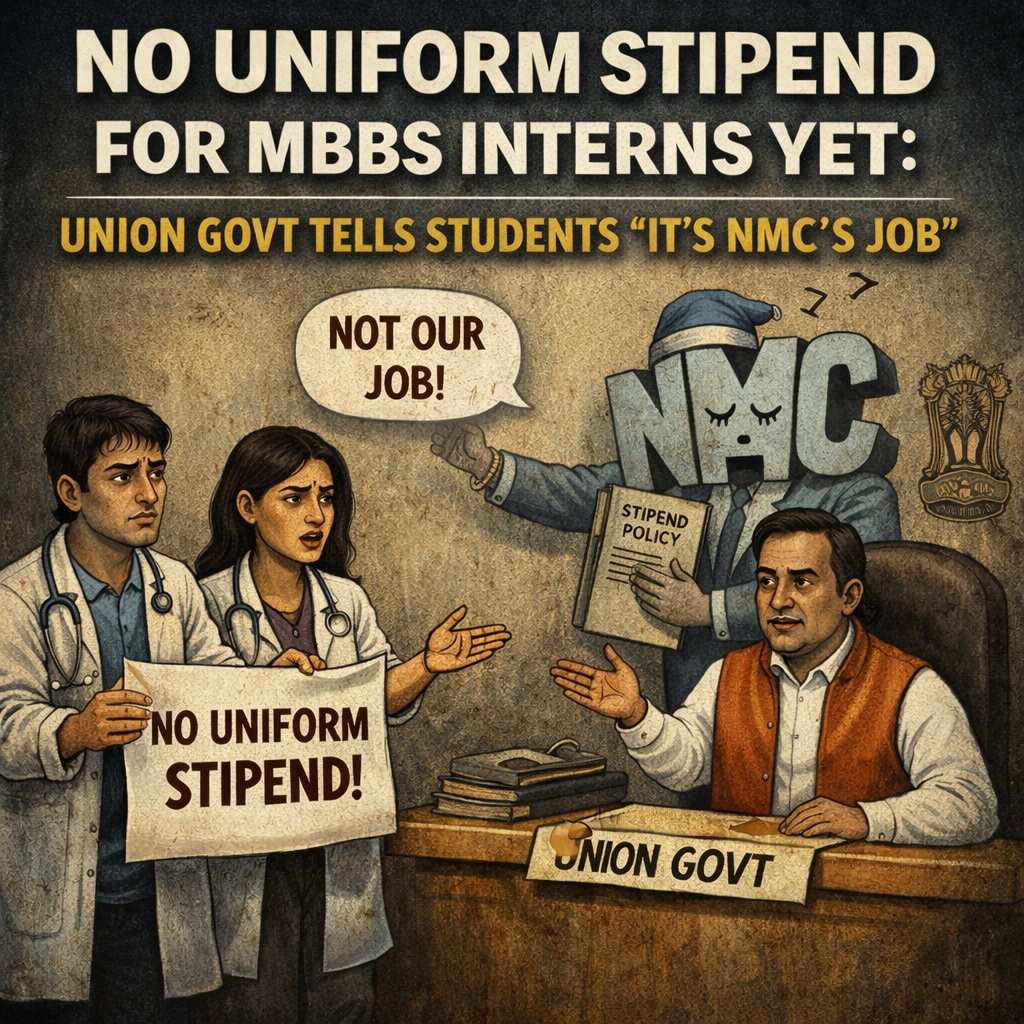
In a major development this month, the Union Ministry of Health and Family Welfare has officially responded to the long standing “One Nation, One Stipend” demand. Their clear message? No further action from the Centrematter lies entirely with the National Medical Commission (NMC).
What Exactly Is the MBBS Intern Stipend Disparity?
The Compulsory Rotating Medical Internship (CRMI) Regulations 2021, framed by the NMC, mandate that every medical intern mustreceive a stipend. The rule was introduced to ensure fair compensation for the long hours, night shifts and patient care responsibilities that interns shoulder.
Yet, implementation remains highly uneven:
Government medical colleges(including state-run and central institutes like AIIMS) typically pay between ₹18,000 and ₹32,000 per month.
Private and deemed medical collegesoften pay between ₹5,000 and ₹18,000.
In extreme cases reported to the NMC, dozens of colleges have paid zero stipend.
This “equal work, unequal pay” situation has sparked widespread resentment among medical students who argue that patient load and clinical exposure are similar across institutions.
April 2026 Update: Government’s Official Stand
According to a recent RTI reply and reports published on 14 April 2026, the Union Ministry of Health and Family Welfare has stated that it will not take any further stepsto enforce uniform stipends. The Ministry has clarified that the issue falls squarely under the regulatory domain of the National Medical Commission (NMC).
This response comes after years of student petitions, multiple reminders from the Health Ministry to the NMC, and ongoing Supreme Court hearings. The “One Nation, One Stipend” campaign which sought a uniform minimum stipend across all medical colleges in India has now been handed back to the NMC for any future action.
NMC had earlier acknowledged the problem and even imposed fines on colleges for failing to submit stipend-related data. However, actual enforcement of payments remains inconsistent.
Why Does This Huge Pay Gap Exist?
Several structural reasons contribute to the disparity:
State wise Budget Differences: Stipend amounts are often decided by individual state governments based on their financial health.
Private College Economics: Many private institutions argue that they already charge high tuition fees and receive limited government funding, making high stipends unsustainable.
Lack of Strong Enforcement Mechanisms: While regulations exist on paper, ground-level monitoring is weak.
Institutional Autonomy: Deemed universities and private colleges enjoy significant flexibility in setting their own policies.
Supreme Court Involvement: A Timeline
The issue has been before the Supreme Court since 2022. Apex court has repeatedly expressed concern over the disparity and has directed the NMC to address it on multiple occasions. Despite this, concrete nationwide reforms have been slow to materialise.
The latest government clarification in April 2026 essentially reinforces that the ball is now in the NMC’s court.
Real Impact on Medical Students and Interns
The stipend disparity isn’t just a numbers game it affects real lives:
Financial Stress: Many students come from middle class families and carry education loans. A low or zero stipend during the internship year adds significant pressure.
Demotivation During Training: Interns handling identical responsibilities feel undervalued when their peers in government colleges earn 2–3 times more.
Career Choices: Some students deliberately prefer government colleges during counselling solely for better internship pay, sometimes compromising on other factors like location or reputation.
Mental Health: The combination of heavy clinical duties and financial uncertainty contributes to burnout among young doctors.
State Wise Stipend Snapshot (Approximate 2025–2026 Figures)
State / Category
Government Colleges (₹/month)
Private Colleges (₹/month)
Delhi
25,000 – 32,000
10,000 – 20,000
Maharashtra
20,000 – 28,000
8,000 – 18,000
Karnataka
18,000 – 25,000
5,000 – 15,000
Tamil Nadu
20,000 – 26,000
7,000 – 16,000
Uttar Pradesh
18,000 – 24,000
5,000 – 12,000
Premier Institutes (AIIMS etc.)
25,000 – 32,000
N/A
Some Deemed/Private Colleges
N/A
0 – 8,000
Note: Figures are indicative and can vary slightly. Always verify latest details directly with the college or state medical council.
What Should Aspiring Doctors Do?
While waiting for systemic change, here are practical steps you can take:
Research Thoroughly Before Counselling: Ask current interns on platforms like Reddit (r/indianmedschool) or Telegram groups about actual stipend and working conditions.
Join the Voice for Change: Many student associations and doctor forums continue to advocate for uniform stipends. Your participation matters.
Document Everything: If you face non-payment or delayed payment during internship, maintain records and escalate through proper NMC channels.
Focus on Skill Development: Treat the internship as a learning opportunity first experience and skills you gain often outweigh the immediate financial difference in the long run.
Pros and Cons of a Uniform “One Nation, One Stipend” Policy
Pros:
Promotes fairness and equality
Reduces financial stress on interns
Improves overall morale and quality of training
Cons:
May increase financial burden on private colleges
Could lead to higher fees for future students
Implementation across 700+ medical colleges would be challenging
Frequently Asked Questions (FAQs)
Q1. Is stipend mandatory for MBBS interns? Yes. As per CRMI Regulations 2021, every intern must receive a stipend.
Q2. Can private colleges pay zero stipend? Technically no, though some colleges have been reported to do so. The NMC has the power to take action against non-compliant institutions.
Q3. Has the Supreme Court given any final order? The matter is still under consideration. The court has directed the NMC to address the disparity but no nationwide uniform rate has been mandated yet.
Q4. Will the April 2026 government response change anything immediately? No immediate change. It shifts the onus back to the NMC.
Q5. How can I check the stipend of a particular college? Contact current interns, check the college website or reach out to the state medical council.
The Road Ahead
The April 2026 clarification from the Health Ministry does not mean the end of the road. The NMC still holds the authority to amend regulations, enforce stricter compliance, and work towards greater parity.
Until then, demand for “One Nation, One Stipend” continues to echo in medical colleges across India. Fair compensation for equal work remains a basic expectation and medical students are right to keep pushing for it.
What do you think? Should there be a uniform minimum stipend for all MBBS interns in India? Have you faced stipend issues during your internship or know someone who has? Share your thoughts and experiences in the comments below.
We’ll keep tracking this story and bring you the latest updates from the NMC and Supreme Court. Subscribe to our newsletter and follow us for more honest, timely insights on medical education in India.
Disclaimer: This article is for informational and educational purposes only. Students should always refer to official NMC and state government notifications for the most accurate information.
Final year MBBS student with strong clinical knowledge in medicine, pharmacology, pathology and evidence based research. In depth knowledge of global geopolitics and its effects on healthcare systems, supply chains and international health regulations
The National Testing Agency has officially announced the new date for the NEET UG 2026 re examination after cancelling the earlier exam due to the alleged paper leak controversy. The re exam will now be conducted on June 21, 2026, affecting more than 22 lakh medical aspirants across India.
PMOS, previously known as PCOS, is a newly renamed condition that better reflects its hormonal and metabolic effects beyond the ovaries. The change from Polycystic Ovary Syndrome to Polyendocrine Metabolic Ovarian Syndrome highlights its association with insulin resistance, obesity, fertility issues, and long term health risks affecting millions of women worldwide.
Tamil Nadu Chief Minister C. Joseph Vijay has once again intensified the debate around the National Eligibility cum Entrance Test (NEET) by urging the Union Government to completely abolish the examination system for medical admissions. His statement came after fresh controversy surrounding the alleged NEET UG 2026 question paper leak, which led to widespread criticism across the country.