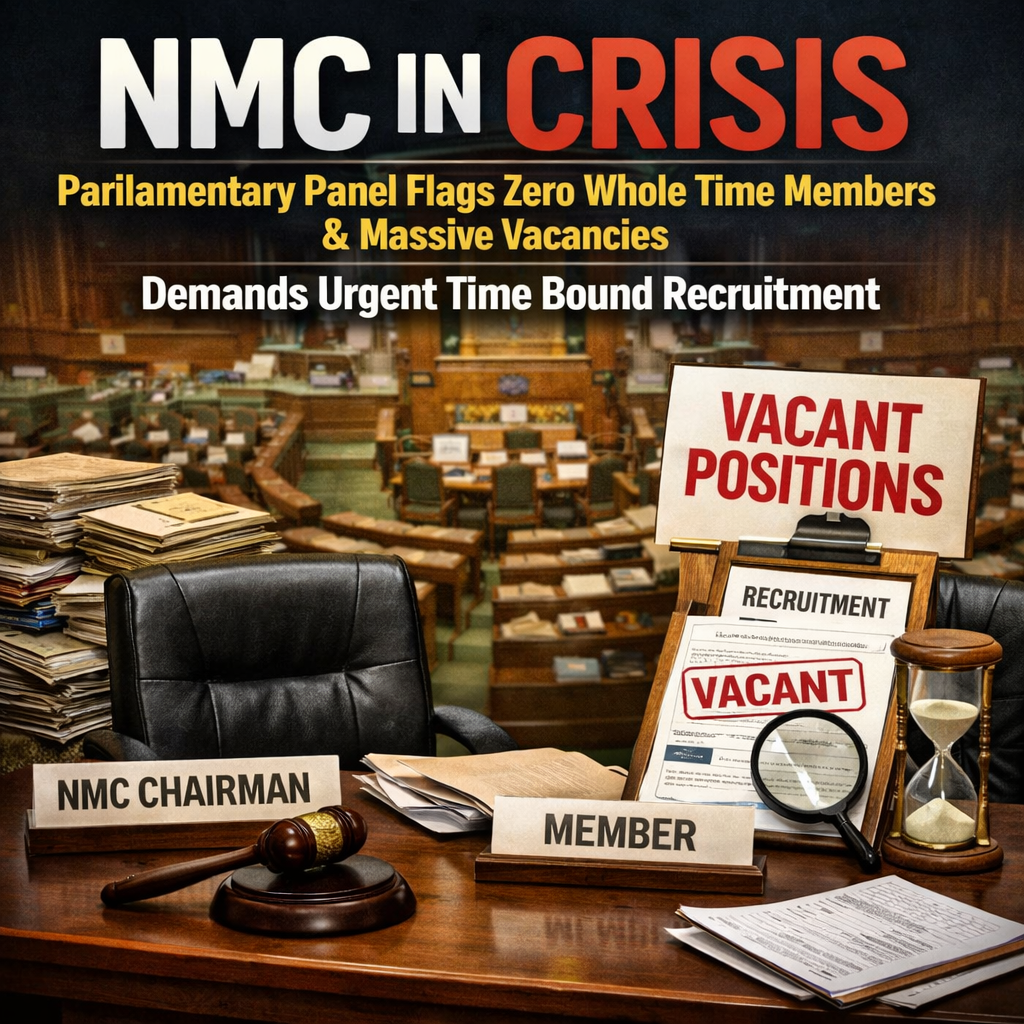
This isn’t just an internal administrative issue it directly affects the quality of medical education regulation of over 800 medical colleges and ultimately the future of healthcare for 1.4 billion Indians.
Understanding the National Medical Commission (NMC)
Established under the National Medical Commission Act, 2019 NMC replaced the older Medical Council of India (MCI) to bring transparency, efficiency, and modern governance to medical education and practice in India.
The NMC operates through four autonomous boards:
- Undergraduate Medical Education Board (UGMEB)
- Postgraduate Medical Education Board (PGMEB)
- Medical Assessment and Rating Board (MARB)
- Ethics and Medical Registration Board (EMRB)
These boards handle everything from setting curriculum standards and conducting assessments to rating medical colleges, registering doctors and enforcing ethical guidelines. With India’s medical college count now touching 818, NMC’s role has never been more critical or more stretched.
The Alarming Reality: Massive Vacancies at the Top
The Parliamentary panel’s report paints a concerning picture. Key highlights include:
- 17 statutory posts and 36 encadred administrative posts currently vacant.
- Zero whole time members (0 out of 8 sanctioned) in the autonomous boards.
- 2 out of 10 ex officio members and 3 out of 22 part time members vacant in the main Commission.
- 4 out of 8 part time member positions empty in the autonomous boards.
- Additional vacancies in CSS Cadre (11 out of 45) and CSSS Cadre (25 out of 60) posts.
To make matters worse, NMC has outsourced 236 staff members on a contractual basis including 66 consultants and 170 DEOs, MTS and drivers. Panel explicitly noted that this heavy dependence on temporary workers “compromises institutional accountability, dilutes a sense of belongingness, and raises the risk of unethical practices.”
For context, earlier this year (February 2026), government had already admitted in the Rajya Sabha that 19 out of 54 sanctioned posts across the NMC and its boards were vacant nearly one third of the total strength.
What the Parliamentary Panel Actually Said
The Committee didn’t mince words. In its report presented to Parliament, it observed:
“While the National Medical Commission (NMC) has successfully overseen a massive expansion of medical education capacity, reaching 818 colleges, its own regulatory architecture is suffering from acute personnel deficits.”
It further highlighted the “absolute vacancy in the crucial category of Whole Time Members in Autonomous Boards” and recommended that the Health Ministry urgently initiate a time bound recruitment process to fill every statutory, ex officio and encadred vacancy.
The panel also flagged the risks of relying so heavily on contractual staff, warning that it could undermine long term institutional stability.
Why This Crisis Matters for Every Indian
The implications go far beyond office desks in New Delhi:
- Delayed Decision Making in Medical Education
With key boards running on skeleton staff, processes like college inspections, curriculum updates, NEET PG seat matrix finalization and super specialty seat approvals could slow down significantly. - Quality of Future Doctors at Stake
The UGMEB and PGMEB are responsible for maintaining uniform standards across MBBS and postgraduate programs. Vacancies here risk inconsistent training quality at a time when India is rapidly expanding medical seats. - Impact on Practicing Doctors
The Ethics and Medical Registration Board handles registration, ethical complaints, and disciplinary actions. Delays or gaps could affect timely grievance redressal and licensing processes. - Patient Safety and Healthcare Regulation
A weakened regulator means slower response to issues like fake degrees, substandard colleges, or unethical practices in the medical field. - Broader Governance Concerns
The irony is hard to miss: the same NMC that directs states to fill faculty vacancies in medical colleges is itself struggling with leadership gaps.
Earlier Warnings and Ongoing Challenges
This isn’t the first time the issue has surfaced. In February 2026, government confirmed multiple vacancies including presidents of the UGMEB and EMRB. Several whole time and part time member positions across boards have remained unfilled for months.
The NMC’s rapid growth in oversight responsibility driven by the addition of hundreds of new medical colleges in recent years has clearly outpaced its internal capacity building. While part time members have been appointed in the past through draws of lots, complete absence of full time leadership in autonomous boards is unprecedented and unsustainable.
The Way Forward: Time Bound Recruitment Is Just the Beginning
The Parliamentary panel’s call for time bound recruitment is a strong and practical first step. Here’s what could make it truly effective:
- Fast track transparent selection processes for whole time members and key administrative roles.
- Clear timelines (e.g., 3–6 months) with accountability at the Ministry level.
- Focus on attracting experienced medical administrators, academicians and regulatory experts.
- Long term workforce planning to avoid future crises as medical education continues to expand.
Additionally, the NMC could consider digital tools and process automation to reduce dependency on manual staffing for routine tasks, while strengthening core regulatory functions.
Final Thoughts: Strengthening the Guardian of Medical Education
India’s ambition to become a global healthcare leader hinges on a robust, well staffed medical regulator. The NMC has done commendable work in expanding access to medical education, but its own structural weaknesses cannot be ignored any longer.
The Parliamentary panel’s report is a timely reminder: a regulator cannot effectively govern if it is itself understaffed and under resourced. Urgent action on these vacancies is essential to restore full functionality, maintain public trust and ensure that India’s future doctors receive the high quality education and ethical oversight they and their patients deserve.
What are your thoughts on this development? Do you believe time bound recruitment can solve the NMC’s staffing crisis, or is deeper reform needed? Drop your views in the comments below.
Stay updated with the latest on NMC policies, medical education reforms and healthcare news. Subscribe to our newsletter and follow us on social media for more insightful analysis.