This revelation comes at a time when India is aggressively trying to increase MBBS seats to meet the growing demand for doctors. Let’s break down what this really means for students, colleges, and the future of healthcare in our country.
What Exactly is the PPP Model in Medical Education?
The PPP (Public Private Partnership) model was introduced to solve two big problems at once:
- Shortage of medical seats
- Underutilized district hospitals across India
Under this model, private medical colleges (or companies) partner with state governments to set up or upgrade medical colleges attached to existing district hospitals. The private partner invests in infrastructure, faculty and modern facilities, while the government provides the hospital for clinical training.
Key benefits the government hoped for:
- Faster increase in MBBS seats without building entirely new hospitals
- Better equipped district hospitals serving rural populations
- High quality medical education at relatively lower costs compared to fully private colleges
In 2023-2024, NMC made significant changes to the rules, allowing even for profit companies to participate. States like Madhya Pradesh, Uttar Pradesh, Rajasthan and others started floating expressions of interest. On paper it looked like a win-win. but the latest parliamentary reply (as reported on 13 April 2026) paints a different picture.
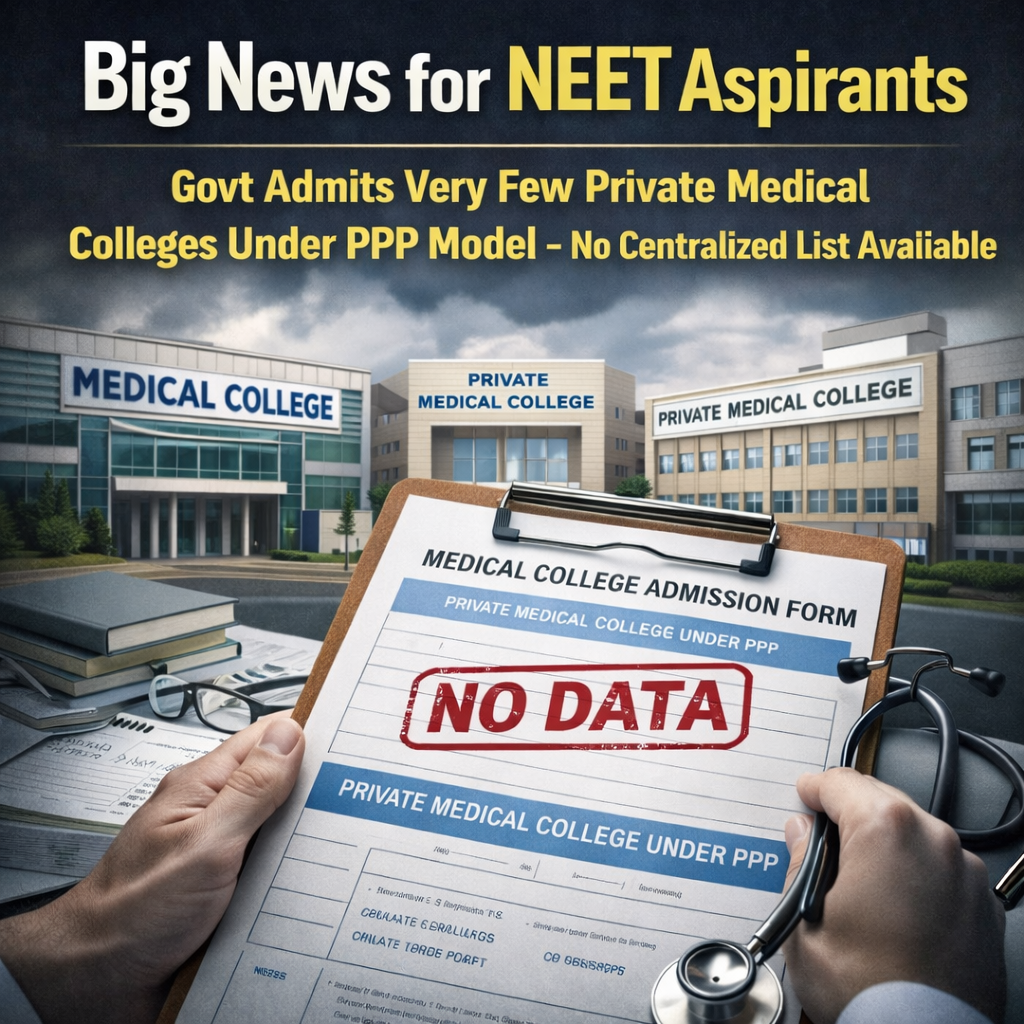
The Government’s Clear Statement: Few Colleges, No List Maintained
In response to questions raised in Parliament, the government stated:
“NMC says few private medical colleges under PPP linked to district hospitals, no list maintained.”
This means:
- The actual number of fully operationalPPP linked private medical colleges is very small.
- There is no official compiled listat the central level tracking which colleges are running successfully under this model.
- Approvals may have been given in several states, but ground-level implementation has been slow.
This is significant because many students and parents assume that “PPP colleges” automatically mean better infrastructure or more affordable fees. The reality, according to the government itself is far more limited.
Why is This News Important for NEET Aspirants?
If you’re preparing for NEET 2026 or 2027, here’s what you should know:
- Don’t Assume Every New College is PPP
Many new medical colleges claim to be “attached to district hospitals.” Always verify the exact nature of the tie-up. A true PPP model has specific NMC guidelines on infrastructure, faculty, and hospital bed strength. - Seat Availability May Not Increase as Fast as Expected
The PPP model was supposed to add thousands of seats quickly. The government’s admission that only “a few” are operational suggests the pace is slower than planned. - Focus on Established Colleges First
For the next couple of counselling rounds, it might be safer to target government colleges, established private colleges, or deemed universities rather than betting on newly approved PPP ones. - Transparency Gap
The fact that no centralized list is maintained makes it harder for students to do proper research. Parents often end up relying on college websites or local agents, which can be misleading.
Challenges Facing the PPP Model Right Now
From what experts are observing, several practical hurdles are slowing down the PPP model:
- High Investment Required: Setting up a medical college still costs hundreds of crores. Many private players are hesitant despite the relaxed rules.
- Regulatory Clearances: Multiple approvals from NMC, state governments, and local bodies take time.
- Operational Issues: Running a teaching hospital attached to a district hospital brings its own set of administrative and quality control challenges.
- State wise Variations: While some states (like Madhya Pradesh and Uttar Pradesh) have shown interest, actual operational colleges remain limited.
The Bigger Picture: India’s Doctor Shortage
India still faces a significant doctor-patient ratio gap. The NMC and government are under pressure to add 10,000+ MBBS seats every year. The PPP model was one of the innovative solutions, but this latest update shows we still have a long way to go.
On the positive side:
- The government is actively monitoring the situation.
- More states are expected to push PPP projects in the coming years.
- Recent policy changes (allowing for profit entities) may attract bigger investors.
What Should Students and Parents Do?
Research Thoroughly: When a college claims a district hospital attachment, ask for specific NMC approval documents under the PPP model.
Check Official Sources: Keep an eye on the NMC website and your state medical council for verified lists.
Consider All Options: Government quota seats, state counselling and management quota understand the fee structure clearly.
Stay Updated: Follow reliable medical education portals because rules change frequently.
Final Thoughts
The government’s candid admission that only a few private medical colleges are actually functioning under the PPP model and that no official list exists is a reality check for everyone in the medical education ecosystem.
It highlights both the ambitionbehind the PPP initiative and the practical challengesin executing it at scale. For aspiring doctors, this means the dream of more affordable, high quality MBBS seats in district hospital linked colleges is still work in progress. As India continues its journey toward becoming a global healthcare leader, updates like this remind us that quality and transparency must go hand in hand with quantity.
What are your thoughts? Have you come across any PPP linked medical college during counselling? Share your experience in the comments below let’s help future aspirants make informed choices!