The NCDRC has clarified an important legal principle in a medical negligence case from Maharashtra, holding that “no cure is not negligence” and that failure of treatment alone cannot be equated with medical negligence. In a case alleging post injection radial nerve palsy, the Commission found no proof of negligent treatment and dismissed the complaint against the doctor.
Alleged Post Injection Radial Nerve Palsy: NCDRC Clears Doctor of Medical Negligence
The National Consumer Disputes Redressal Commission (NCDRC), New Delhi, decided Revision Petition No. 4551 of 2013 on 22 June 2020 in the case of Sunandabai Kisnaji Dhole versus Dr. Vinod Bele. The revision petition arose from an order of the Maharashtra State Consumer Commission dated 23 April 2013, which had set aside the District Forum’s finding of medical negligence.
The complainant was a resident of Wardha district, Maharashtra, and the respondent doctor, Dr. Vinod Bele, was practicing at Akansha Clinic, Anji (Mothi), Wardha. The matter was heard and decided by Hon’ble Dr. S. M. Kantikar, Presiding Member, NCDRC.
Background of the Case
The case relates to an allegation that Dr. Vinod Bele caused radial nerve injury by negligently administering an injection in the patient’s arm. The complainant alleged that on 8 October 2001, the doctor administered a Diclofenac injection in her left arm instead of a safer muscular site like the buttock, which allegedly resulted in “high radial nerve palsy” and permanent disability.
Initially, the District Forum held the doctor guilty of medical negligence. However, the doctor challenged this order before the State Commission, which allowed the appeal and dismissed the complaint. Aggrieved by this, the complainant approached the NCDRC by filing a revision petition. There was a delay of 127 days in filing the revision petition, which was condoned by the Commission on 24 July 2014.
Arguments of the Complainant
The complainant argued that the doctor had chosen an improper site for injection and administered Diclofenac in the left arm in a negligent manner without reasonable care and skill. It was claimed that immediately after this injection, the patient developed high radial nerve palsy and suffered permanent disability.
Reliance was placed on Supreme Court judgments including Spring Meadows Hospital vs Harjot Ahluwalia and Nizam Institute of Medical Sciences vs Prashant Dhananka. The complainant also produced some medical literature regarding radial nerve injuries to support the claim that such injury can occur due to improper injection techniques.
Defence Taken by the Doctor
The doctor completely denied administering any injection on 8 October 2001. It was argued that the patient was under treatment from May 2001 to September 2001 for arthritis and joint pains. During that period, the doctor had given a Diclofenac injection once, after which the patient had improved.
It was further stated that in September 2001, the patient was referred to Kasturba Hospital, Mahatma Gandhi Institute of Medical Sciences (MGIMS), Sevagram, for further management. On 8 October 2001 and 16 October 2001, the doctor had only prescribed oral medicines like painkillers and steroids, and no injection was given on those dates.
The doctor also pointed out that he is a qualified anesthetist and anesthetists are specifically trained in safe techniques of administering injections, whether intramuscular or intravenous. Medical textbooks including K.D. Tripathi’s Essentials of Medical Pharmacology and standard orthopedic references like Campbell’s Operative Orthopaedics were cited to explain the anatomy and causes of radial nerve injury.
What the Medical Records Showed
On careful examination of the record, the Commission found that there were only two prescriptions available from the doctor, dated 8 October 2001 and 16 October 2001. Both prescriptions mentioned only oral medicines and did not mention any injection.
There was no documentary proof that any injection was administered on 8 October 2001. It was also noted that the patient had been referred to MGIMS Sevagram, where she was treated on an OPD basis for arthritis.
Delay in Reporting the Alleged Injury
A very important factor considered by the Commission was the timeline. If the alleged injection had been given on 8 October 2001 and caused radial nerve palsy, the patient should have reported immediately. However, the patient last visited the doctor on 16 October 2001 and only complained of arthritis, for which medicines were prescribed.
The patient approached MGIMS only on 26 December 2001, which is nearly 70 days after the alleged injection. There was no explanation or record of what treatment she took or what happened during this long intervening period. This made it extremely difficult to link the alleged nerve injury to the doctor’s treatment.
Medical Science on Radial Nerve Injury
The Commission discussed medical literature and observed that injection related nerve injuries are known in medical science, but they are not the only cause of radial nerve palsy. The radial nerve is actually the most commonly injured nerve in the upper limb, and the most frequent cause is fracture of the middle third of the humerus.
Other causes include compression, traction, fibrotic bands, surgical trauma, ganglion near the elbow, severe muscular effort, and ischemia. Therefore, radial nerve palsy can occur due to multiple reasons and not necessarily because of a wrongly given injection.
Opinion of MGIMS Doctors
The affidavits and reports of Dr. C. M. Badole, Professor of Orthopaedics, and Dr. Amit Chaturvedi, Lecturer in Orthopaedics at MGIMS, were considered by the Commission. They stated that the injury was curable and the patient had shown signs of recovery during treatment at MGIMS over four months.
However, the patient stopped coming for follow up. The doctors also opined that the disability was more likely due to long standing arthritis rather than any permanent nerve damage.
Questionable Medical Certificate
The complainant produced a certificate dated 21 November 2013 issued by an Ayurveda doctor stating that the patient was suffering from left hemiplegia since 2001. The Commission found this certificate unreliable because it appeared to be based only on the patient’s history and not on any detailed clinical examination. No affidavit or supporting evidence from that doctor was produced.
Failure to Prove Medical Negligence
The Commission clearly noted that the complainant failed to produce any expert opinion or credible evidence to prove that the doctor had negligently administered an injection or that such injection caused radial nerve palsy.
On the contrary, medical literature itself shows that nerve injuries can occur due to many causes such as compression, traction, contusion, ischemia, burns, or friction.
Important Legal Principle: No Cure Is Not Negligence
The Commission reiterated a very important legal principle in medical negligence law. Merely because a patient does not improve or is not cured does not mean the doctor is negligent. If reasonable skill and care have been exercised, failure of treatment cannot be equated with negligence.
In this case, the doctor had treated the patient for arthritis and appropriately referred her to a higher center. The patient did receive treatment but did not completely recover. That by itself cannot make the doctor legally liable.
Final Decision of the NCDRC
After considering all records, medical literature, and arguments, the NCDRC found no error in the order passed by the State Commission. It held that medical negligence or deficiency in service was not proved against the doctor.
Accordingly, the revision petition was dismissed and the doctor was finally cleared of all allegations of medical negligence.
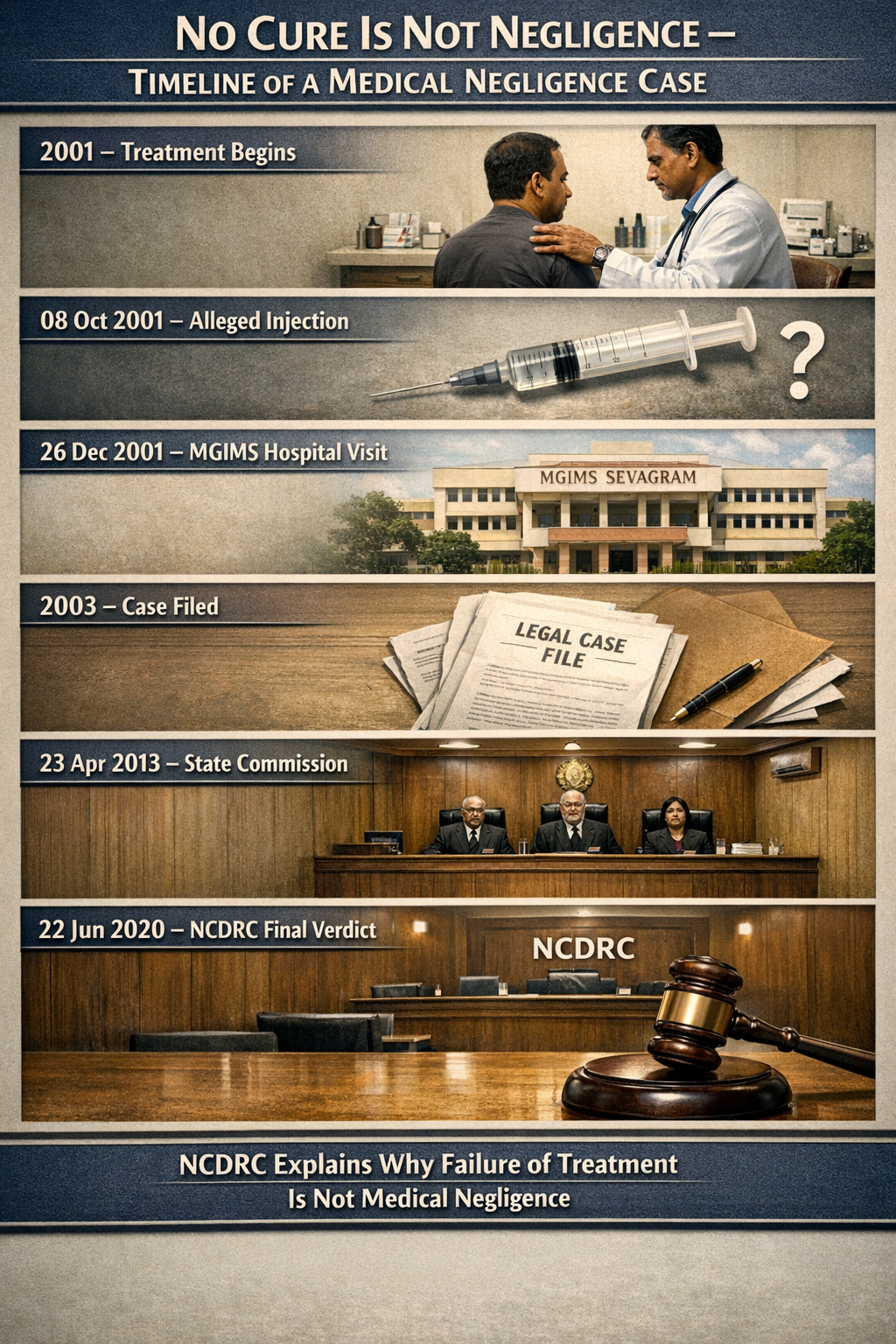
Timeline of the Case:
Why This Judgment Is Important for Doctors
This case highlights how crucial proper documentation, referral notes, and treatment records are in defending doctors against false or unproven allegations. It also reinforces the principle that complications or incomplete recovery do not automatically mean negligence, especially when medical science itself recognizes multiple possible causes for such conditions.
It also shows that courts require strong, scientific, and expert evidence to hold a doctor guilty and will not rely merely on allegations or belated certificates.
Source: Order of the National Consumer Disputes Redressal Commission (NCDRC), New Delhi in Revision Petition No. 4551 of 2013, decided on 22 June 2020.
Uttar Pradesh introduces a major medico legal reform allowing post mortems in government and approved private medical colleges under the leadership of Brajesh Pathak. The policy aims to reduce delays, improve forensic training, enhance transparency and strengthen justice delivery across Uttar Pradesh.
Dramatic rise in C-section deliveries in India, now over 27% in 2024-25 A fourfold increase in 16 years. This blog dives into government data, reasons like private sector incentives and patient preferences, health risks, and solutions for balanced maternity care.
Medico-legal landscape of euthanasia in India, focusing on passive euthanasia and advance directives (living wills). From landmark Supreme Court rulings like Aruna Shanbaug (2011) and Common Cause (2018 & 2023) to patient autonomy and ethical considerations in end-of-life care.