The NEET-PG cutoff has been reduced to zero percentile, allowing even negative-score candidates to become eligible for MD/MS seats. This detailed analysis explains how this decision to fill private medical college seats will dilute medical standards, increase medical negligence cases, and damage the future of Indian healthcare and hardworking doctors.
NEET-PG Cutoff Reduced to Zero Percentile: A Dangerous Collapse of Standards
A Decision That Should Alarm Every Doctor and Patient
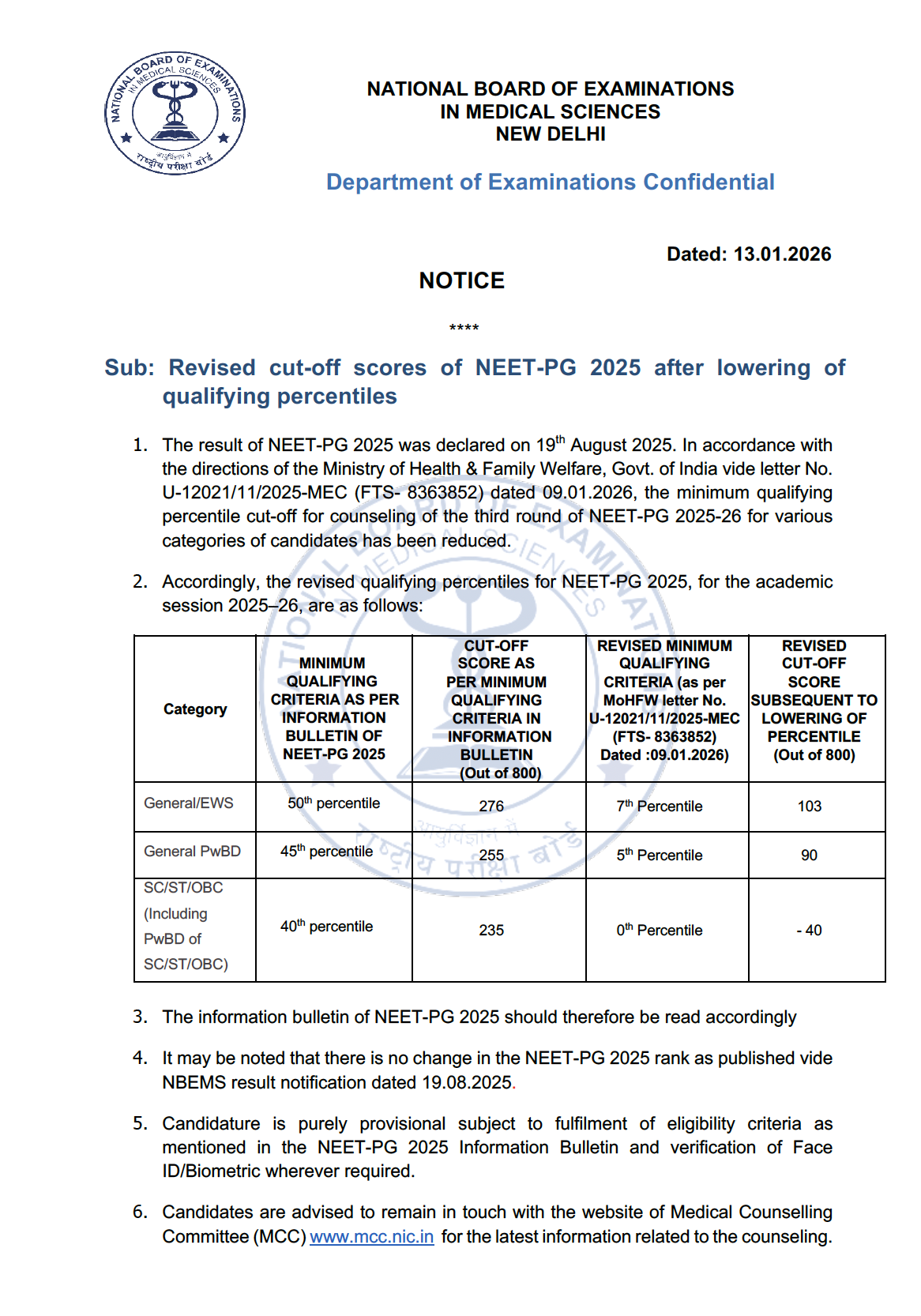
On January 13, 2026, the government, through the National Board of Examinations in Medical Sciences (NBEMS) and the Medical Counselling Committee (MCC), announced a drastic and deeply controversial change in the eligibility criteria for NEET-PG 2025 counselling. The qualifying percentiles for admission to postgraduate medical seats in MD and MS courses were slashed dramatically. For the general category, the cutoff was reduced from the 50th percentile to the 7th percentile. For persons with benchmark disabilities, it was reduced from the 45th percentile to the 5th percentile. For SC, ST, and OBC categories, it was reduced from the 40th percentile to zero. This effectively means that even candidates who scored as low as minus 40 marks out of 800, due to negative marking, are now technically eligible to compete for postgraduate medical seats. This is not a minor policy tweak. This is a structural collapse of the very idea of merit, competence, and minimum standards in specialist medical training.
From Merit Based Selection to Desperation Driven Seat Filling
Officially, the justification offered is that thousands of postgraduate medical seats were lying vacant after multiple rounds of counselling. Instead of asking why these seats remain unfilled, instead of questioning fee structures, quality of institutions, or unchecked expansion of private colleges, the system has chosen the most dangerous shortcut possible: remove the eligibility barrier itself. This decision has nothing to do with strengthening healthcare. It is a desperate attempt to ensure that no seat, especially in private colleges, remains unsold.
When a National Entrance Exam Loses Its Meaning
The entire purpose of NEET-PG was to act as a national benchmark to ensure that only candidates with a minimum acceptable level of knowledge and competence enter specialist training. If the qualifying benchmark is pushed to near zero, the exam becomes a meaningless formality. An entrance test that cannot meaningfully filter candidates is not a selection process. It is merely a registration exercise.
A Policy That Protects Business, Not Patients
Let us be clear about the real beneficiaries of this decision. This policy does not benefit patients. It does not benefit public healthcare. It does not even benefit medical education. It primarily protects the financial interests of institutions that have expanded indiscriminately, charged exorbitant fees, and now struggle to fill their seats. Instead of regulating costs and quality, the government has chosen to dilute standards. When standards come in the way of revenue, standards are simply sacrificed.
The Dangerous Illusion of Solving Doctor Shortage
This move is being projected as a way to increase the number of specialists and address the shortage of doctors. But producing more degrees does not produce better doctors. Lowering entry standards does not strengthen the healthcare system. It weakens it from within. Quantity without quality is not a solution. It is a slow, systemic disaster.
The Price Will Be Paid in Hospitals and Courtrooms
The real consequences of this decision will not only be visible in wards, operation theatres, emergency rooms, and outpatient departments, but also increasingly in courtrooms and consumer forums. Poorly trained specialists, compromised clinical judgment, and avoidable medical errors will inevitably lead to a sharp rise in medical negligence cases and compensation claims. This will further fuel the already growing culture of defensive medicine, fear driven practice, and legal vulnerability in the profession.
How This Will Destroy the Reputation of Honest Doctors
The tragedy is that the burden of this will not fall on policymakers or college owners. It will fall on sincere, hardworking doctors who practice ethically and competently. As negligence cases rise and public trust erodes, the entire profession will be viewed with suspicion. The image of doctors, already under strain, will deteriorate further, and every complication will be seen through the lens of incompetence or misconduct, regardless of reality.
A Slap in the Face of Sincere and Hardworking Students
This decision also sends a deeply demoralising message to students who studied sincerely, prepared honestly, and respected the exam. It tells them that effort does not matter, competence does not matter, and standards do not matter. It tells them that the system rewards desperation and punishes discipline.
A Symptom of Deeper Failure in Medical Education Planning
This crisis is not accidental. It is the result of years of unplanned expansion of postgraduate seats without proportional increase in faculty, infrastructure, patient load, or training quality. Now that the system is unable to absorb its own excess, instead of correcting the root causes, it is dismantling the last remaining filters.
From Healthcare Reform to Institutionalised Mediocrity
A nation does not become medically strong by producing more specialists on paper. It becomes strong by protecting the quality and credibility of those specialists. If this is the direction Indian medical education continues to take, we are not heading towards reform. We are heading towards a future where the title of specialist will remain, but the trust behind it will steadily disappear.
Reducing the NEET-PG cutoff to near zero is not just a bad decision. It is a dangerous precedent. Once standards are abandoned for convenience and profit, it becomes very difficult to restore them. Today it is zero percentile. Tomorrow, it will be zero accountability.
The National Testing Agency has officially announced the new date for the NEET UG 2026 re examination after cancelling the earlier exam due to the alleged paper leak controversy. The re exam will now be conducted on June 21, 2026, affecting more than 22 lakh medical aspirants across India.
PMOS, previously known as PCOS, is a newly renamed condition that better reflects its hormonal and metabolic effects beyond the ovaries. The change from Polycystic Ovary Syndrome to Polyendocrine Metabolic Ovarian Syndrome highlights its association with insulin resistance, obesity, fertility issues, and long term health risks affecting millions of women worldwide.
A doctor in Bhilwara allegedly attempted suicide by consuming phenyl after accusing a private hospital operator of financial exploitation, unpaid salary, mental harassment, and police inaction. The incident has sparked concern over workplace conditions and disputes in the medical profession.