In a medical negligence judgment, the NCDRC held a radiologist and imaging centre guilty for failing to detect severe fetal deformities during repeated sonography in pregnancy. The case involved a child born with limb reduction defects after four “normal” ultrasound reports. The NCDRC awarded ₹1.25 crore compensation for lifelong care and suffering.
The use of ultrasonography in modern obstetrics has completely transformed prenatal care. Today, repeated ultrasound examinations during pregnancy are no longer viewed merely as tools to confirm fetal heartbeat or gestational age. They are also expected to play a crucial role in screening for major structural abnormalities. With this advancement has come a parallel rise in medical negligence litigation, especially in cases where congenital anomalies are not detected in time. One of the most important Indian judgments on this issue is the decision of the National Consumer Disputes Redressal Commission (NCDRC) in Udayan & Ors. vs M/s Imaging Point & Ors., decided on 25 May 2022. This case is not merely about a diagnostic error. It is about a lost opportunity, lifelong disability, the emotional devastation of parents, and the legal responsibility of doctors who perform prenatal diagnostic investigations .
The Beginning of the Tragedy
Mrs. Anita Shrouti was under regular antenatal care of a gynecologist during her second pregnancy in 2006–2007. Like most pregnant women, she trusted the medical system and followed every instruction given by her treating doctor. As part of routine pregnancy monitoring, she was referred to M/s Imaging Point, Nagpur, for ultrasonography. The scans were performed by Dr. Dilip Ghike, a radiologist attached to the centre. Over the course of the pregnancy, four ultrasound scans were carried out, the first in November 2006, the second in January 2007 when the pregnancy was around 17 to 18 weeks, the third in March 2007, and the fourth in May 2007 near term. Each of these scans was reported as normal, with repeated statements that there were no congenital anomalies seen in the fetal head, abdomen and spine .
From the parents’ point of view, these reports were reassuring. They had no reason to suspect that anything was wrong. The pregnancy was allowed to continue to full term, and on 26 May 2007, a caesarean section was performed.
The Shocking Discovery at Birth
What followed was something no parent is ever prepared for. At the time of birth, the newborn male child was found to be grossly malformed. He had severe limb defects, including absence of fingers, absence of the right leg below the knee, and absence of the left foot below the ankle. This was not a subtle or borderline abnormality. It was a profound, obvious, life altering congenital malformation. The shock and trauma suffered by the parents at that moment is impossible to fully capture in words. They had gone through the entire pregnancy believing that everything was normal because that is exactly what the ultrasound reports had told them .
Subsequent medical examinations revealed that the problems were not limited to the limbs. The child also had facial palsy, problems with eye closure, micrognathia, difficulties in feeding, and hearing impairment. Over time, it became clear that the child would need lifelong medical care, repeated surgeries, prosthetic limbs, speech therapy, and continuous rehabilitation.
The Long and Painful Medical Journey
In the months and years following the birth, the parents consulted some of the best specialists across the country. The child was evaluated by pediatricians, genetic experts, plastic surgeons, orthopedic surgeons, ophthalmologists and ENT specialists. He was diagnosed with limb reduction defects and associated craniofacial abnormalities. He was advised artificial limb prostheses at a very young age and multiple corrective surgeries as he grows older. Doctors explained to the parents that prosthetic limbs would need to be changed repeatedly as the child grows, meaning that the expenses would not be one time, but recurring throughout his life .
Apart from the financial burden, the emotional and psychological impact on the family was devastating. The mother even had to give up her job to take care of the child full time. The family also had to face social stigma, constant stress, and the pain of watching their child struggle with basic activities that other children perform effortlessly.
The Legal Case: Allegation of Diagnostic Negligence
The parents and the child eventually approached the National Consumer Disputes Redressal Commission alleging medical negligence against the imaging centre and the radiologist. Their core argument was simple but powerful. The anomalies were present in the fetus during pregnancy. At least by the 17 to 18 week scan, these defects should have been suspected or detected. If the anomalies had been identified in time, the parents would have had a legal option to terminate the pregnancy under the Medical Termination of Pregnancy law. That choice was taken away from them because of the incorrect and misleading ultrasound reports .
They claimed a very large amount of compensation under different heads, including actual medical expenses, future medical and prosthetic costs, and compensation for mental agony and lifelong suffering.
The Defence of the Radiologist
The radiologist took the defence that he had only performed routine or Level I scans and not a targeted anomaly scan or Level II scan. He argued that neither the gynecologist nor the patient had specifically asked for an anomaly scan and that he charged only a basic fee for routine ultrasound. He also relied heavily on medical literature to argue that limb anomalies are notoriously difficult to detect and that even in the best centres and best hands, such defects can be missed. He further argued that ultrasound is not a perfect tool and that its accuracy depends on many factors such as maternal body habitus, fetal position, and other technical limitations .
In essence, his case was that there was no negligence because he did what he was asked to do and because medical science itself has limitations.
The AIIMS Expert Opinion and Its Importance
To objectively examine the medical issues, the Commission sought an independent expert opinion from AIIMS, New Delhi. The AIIMS Medical Board confirmed that the child’s condition fell under limb reduction defects. More importantly, the Board stated that limbs should be actively looked for during standard second trimester obstetric ultrasound examinations. While the Board also acknowledged that detection rates for such anomalies are not very high, it clearly indicated that these structures are part of what should be examined and commented upon during routine scans .
This opinion played a crucial role because it established what is expected as a standard of care in such cases.
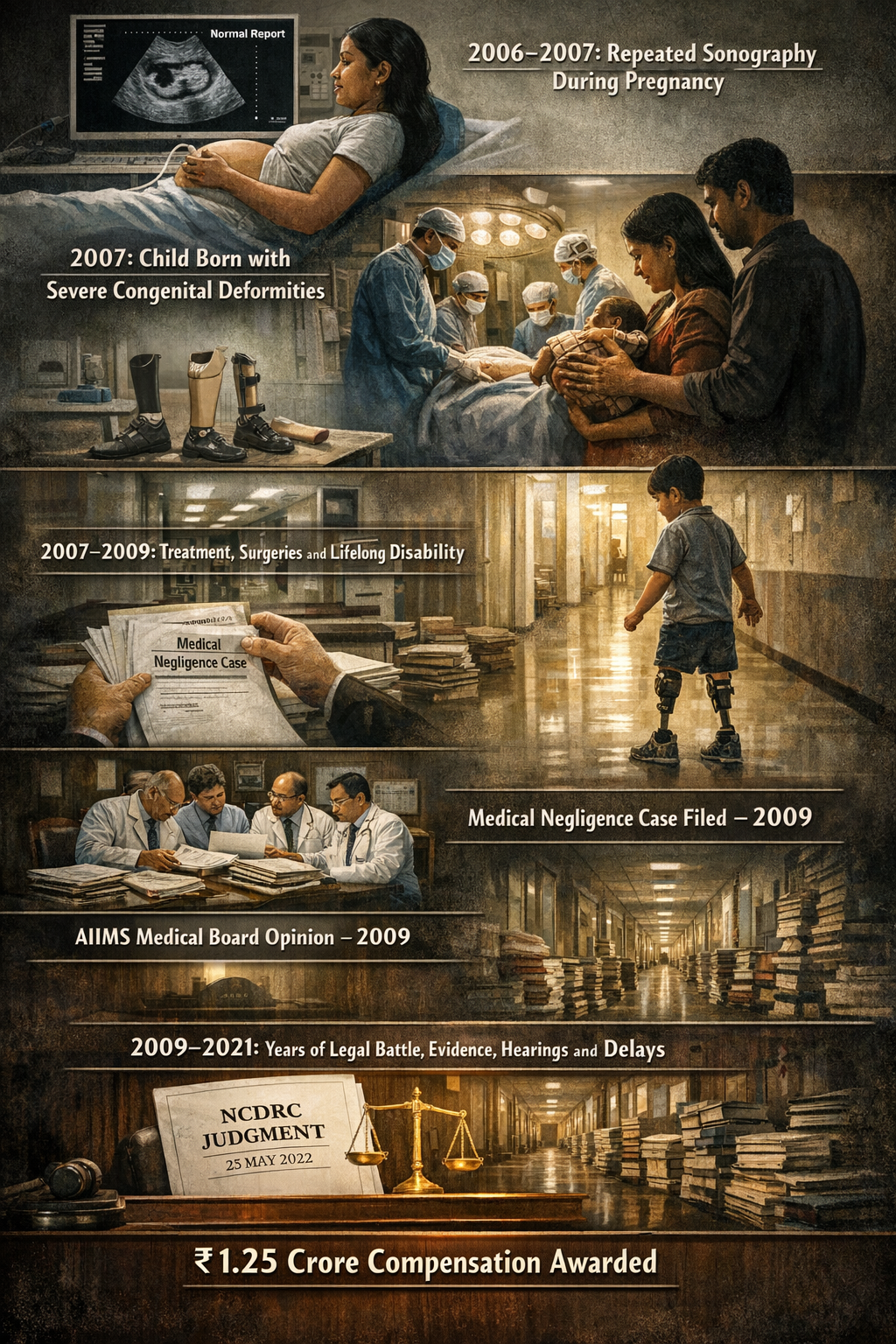
Timeline of The case
Why the Commission Rejected the “Level I vs Level II” Excuse
One of the most significant aspects of this judgment is the Commission’s rejection of the radiologist’s attempt to hide behind technical classifications. The Commission observed that it is not the patient’s duty to know what kind of scan to ask for. It is the professional duty of the radiologist to take proper history, understand the stage of pregnancy, and perform the appropriate standard examination. When a woman comes for a mid trimester scan, the radiologist cannot mechanically limit himself to a basic checklist and ignore obvious and essential structures like limbs .
The Commission noted that in all four reports, there was not even a single line mentioning the limbs. This, in the Commission’s view, was not a mere error of judgment but a clear failure of duty of care.
Application of Medical Negligence Law and the Bolam Principle
The Commission examined the case in the light of multiple Supreme Court judgments including Jacob Mathew, Kusum Sharma and the classic Bolam test. The legal principle is that a doctor is expected to exercise the ordinary skill of a reasonably competent professional in his field. He is not required to be perfect, but he is required to follow accepted standards of practice. In this case, the Commission held that the radiologist failed even this basic standard because he did not properly examine or document essential fetal structures during crucial stages of pregnancy .
The Commission also held that this was a case where the principle of res ipsa loquitur applies, meaning the negligence is self evident. When a child is born with such gross deformities after multiple “normal” scans, the burden shifts to the doctor to explain how such a thing could have happened despite due care.
The Concept of Lost Opportunity
A very important legal and ethical dimension of this case is the concept of lost opportunity. The Commission clearly held that if the anomalies had been detected at 17 to 18 weeks, the parents could have made an informed choice about whether to continue the pregnancy. That choice was taken away from them. The law recognises this as a serious harm, even though the child’s condition itself may be a result of nature .
The Question of Compensation
While the Commission agreed that the parents’ original claim of more than ₹10 crore was exaggerated, it also recognised that the child would require lifelong care, repeated prostheses, and continuous medical attention. It also acknowledged the immense mental agony and social suffering of the parents. Balancing all these factors, the Commission awarded a total compensation of ₹1.25 crore. Out of this, ₹1 crore was to be kept in fixed deposit in the name of the child for his future needs, and ₹25 lakh was to be paid to the parents for mental agony and related expenses. An additional ₹1 lakh was awarded as litigation cost. The amount was directed to be paid within three months, failing which it would carry interest at 7 percent per annum .
Why This Judgment Matters for Doctors
This judgment is a serious warning to radiologists and diagnostic centres. It makes it clear that prenatal ultrasound is not a casual or mechanical exercise. It is a medico legal responsibility. Doctors cannot later say that they were not asked to look for something if that “something” is part of basic standard care. The court has also made it clear that while medicine has limitations, those limitations cannot be used as a shield for not following established guidelines.
Why Did This Case Took 13 Years (2009–2022) to Be Decided?
Although the complaint in this case was filed in 2009, the final judgment was delivered only in May 2022, after more than thirteen years. This long delay was not because the case was ignored, but because it involved highly complex medical, technical and legal questions that required extremely careful judicial examination.
First, this was not a routine consumer dispute. It was a high stake medical negligence case involving prenatal diagnostics, radiology standards, congenital anomaly detection, and lifelong disability of a child. Because of the technical nature of the issues, the NCDRC itself felt it necessary to seek an independent expert opinion from the AIIMS Medical Board in 2009. That opinion became a crucial piece of evidence and had to be studied and tested against multiple international guidelines, medical textbooks and expert opinions filed by both sides.
Second, both parties filed extensive affidavits, medical literature, expert reports and detailed legal submissions over the years. The radiologist and imaging centre produced opinions from senior radiologists and relied on international studies to argue the limitations of ultrasound. The complainants, on the other hand, produced guidelines and authoritative medical texts to show what should have been done. This kind of evidence based adjudication does not happen in a summary manner and proceeds almost like a civil trial on affidavits.
Third, there were procedural developments during the case. Initially, more than one radiologist was made a party. In 2019, the NCDRC passed a separate order deleting one of the radiologists from the array of parties after examining his role. This shows that even after several years, the case was still undergoing procedural refinement before final adjudication.
Fourth, like most long pending matters in India, this case also suffered from the general backlog of courts and tribunals. Medical negligence cases, especially those involving large compensation claims, are usually heard with extreme caution and are listed over multiple dates spanning years.
Finally, the COVID 19 pandemic during 2020 and 2021 further slowed down hearings and final disposal of cases across the judicial system, including before the NCDRC.
In short, this case took thirteen years because it involved complex medical science, multiple expert opinions, voluminous records, procedural hearings, and systemic judicial delays. The timeline itself reflects how exhausting and prolonged the struggle for justice can be for victims of medical negligence in India.
Conclusion
The Imaging Point vs Udayan case is not just a legal decision. It is a story of how a missed diagnosis changed the life of a child and his family forever. It reinforces a fundamental principle of medical law that diagnostic responsibility is as serious as therapeutic responsibility. For the medical profession, especially those involved in prenatal diagnostics, this judgment stands as a reminder that a few careless lines in a report can create a lifetime of suffering for someone else.
Uttar Pradesh introduces a major medico legal reform allowing post mortems in government and approved private medical colleges under the leadership of Brajesh Pathak. The policy aims to reduce delays, improve forensic training, enhance transparency and strengthen justice delivery across Uttar Pradesh.
Dramatic rise in C-section deliveries in India, now over 27% in 2024-25 A fourfold increase in 16 years. This blog dives into government data, reasons like private sector incentives and patient preferences, health risks, and solutions for balanced maternity care.
Medico-legal landscape of euthanasia in India, focusing on passive euthanasia and advance directives (living wills). From landmark Supreme Court rulings like Aruna Shanbaug (2011) and Common Cause (2018 & 2023) to patient autonomy and ethical considerations in end-of-life care.