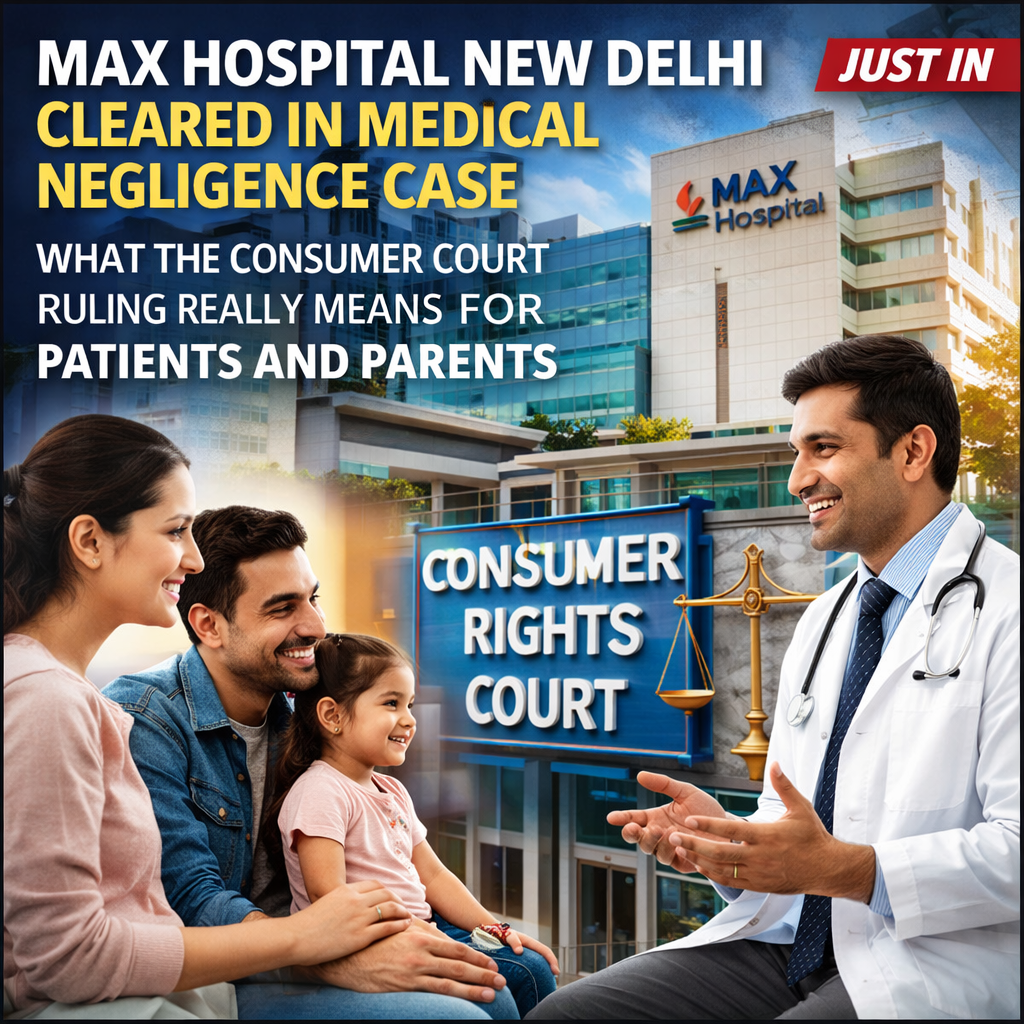
If you’re a parent in India and your child lands in hospital with unexplained pain, last thing you want is to leave feeling more confused than when you arrived. That’s exactly what one father felt back in 2017 when his 14 year old daughter spent time at Max Smart Super Speciality Hospital in Saket, New Delhi. She had been battling recurrent abdominal pain for over a month with a history of typhoid. After consultations with paediatric gastroenterologists, surgeons and eventually psychiatrists, she was diagnosed with anxiety and stress manifesting as somatic (body related) symptoms. She improved and went home.
Fast forward to 2026 and the South Delhi District Consumer Disputes Redressal Commission has just given the hospital and its doctors a clean chit. In a ruling published on 19 April 2026, court held there was no medical negligencein the minor’s treatment, father’s complaint didn’t hold up because he couldn’t produce any solid evidence or expert medical opinion showing the doctors fell short.
This isn’t just another “hospital wins” headline. It’s a practical reminder of how medical negligence cases actually work in India’s consumer courts and why the bar for proving them is (and should be) quite high. In this piece, I’ll walk you through what happened, what the law says, and the real world lessons every patient and family should know. Whether you’re a worried parent, doctor navigating defensive medicine or just someone who wants to understand healthcare disputes better, there’s something useful here.
Case in Simple Terms: What Actually Happened?
Let’s rewind to October 2017. 14 year old girl had been suffering from stomach pain that wouldn’t go away. Her father took her to Max Hospital Saket, paediatric gastroenterologist and paediatric surgeon examined her thoroughly. When the pain persisted despite initial treatment, she was referred to the psychiatry department. diagnosis? Anxiety and stress with somatic symptoms basically, emotional stress showing up as physical pain. She was treated, showed improvement and was discharged on 30 October 2017 with no fresh complaints.
Bill came to about ₹97,446. Family had a mediclaim policy with United India Insurance, which initially sanctioned ₹15,000 but later withdrew it, citing the policy’s exclusion for psychiatric and psychosomatic disorders. Father paid out of pocket and later filed a consumer complaint against both the hospital (for alleged negligence) and the insurence company (for wrongfully denying the claim).
His main gripes against the hospital: doctors started treatment without a proper diagnosis, worked on “assumptions” and referred the girl to psychiatry just to extract more money. He felt his daughter left without real relief.
Hospital’s side was straightforward: they followed a multi specialty approach, documented everything and the patient actually got better. No expert opinion was produced by the complainant to prove otherwise, court’s verdict was clear. After reviewing medical records, it said: “Without any cogent evidence or expert opinion the doctors… cannot be held negligent.” Hospital was completely exonerated. Insurance company however was slapped with ₹25,000 for failing to send a proper repudiation letter on time ,a procedural slip up, not a coverage dispute.
Understanding Medical Negligence in India: It’s Not What Most People Think
People often confuse a bad outcome with negligence. In reality, Indian courts follow a well established standard (inspired by the UK’s Bolam test and refined by our Supreme Court in cases like Jacob Mathew v. State of Punjab). Medical negligence happens only when a doctor’s care falls below what a reasonably competent professional would do in similar circumstances.
Key points most families miss:
- Error of judgment ≠ negligence.Doctors make calls based on what they see at the time. Hindsight is 20/20, but courts don’t judge with it.
- You need proof.A mere allegation isn’t enough. You almost always need an expert doctor’s opinion saying, “This specific step was wrong and caused harm.”
- Complications happen.Even the best hospitals can’t guarantee zero problems, especially with psychosomatic conditions where stress and physical symptoms blur together.
In this Max Hospital case, girl’s symptoms had a real physical presentation but stemmed from anxiety. Referring her to psychiatry wasn’t “giving up” it was good medicine. Somatic symptom disorders are recognised worldwide; treating the mind often resolves the body pain.
Why Consumer Courts Matter in These Disputes
India’s Consumer Protection Act makes filing complaints relatively easy and cheap. no huge court fees, faster hearings than civil suits. That’s why thousands of medical cases land here every year. District Commission (like the one in South Delhi) handles claims up to ₹2 crore but here’s the reality check: winning isn’t automatic. Complainants win only when they prove three things duty of care existed, it was breached and it caused harm. In this case, father couldn’t tick those boxes. His later OPD slips from other hospitals (almost a year after discharge) didn’t help prove the treatment at Max was faulty.
Real life scenario I’ve heard from many parents: A child has vague symptoms. Tests rule out serious issues. A psychiatrist suggests therapy alongside medicine, family feels dismissed. Months later, they sue. Courts repeatedly say: “Show us where the doctor went wrong not just that you’re unhappy.”
Bigger Picture: Defensive Medicine and Patient Trust
Rulings like this one matter because they push back against “defensive medicine”where doctors order extra tests just to avoid lawsuits. That drives up costs and stress for everyone. At the same time, it reminds hospitals that proper communication and timely paperwork (like that repudiation letter) still count.
India needs balance. Patients deserve accountability. Doctors deserve protection when they act reasonably. This case strikes that balance: hospital was cleared, insurer was held to basic standards and no one was punished for a legitimate medical judgment.
Stories like this also highlight something deeper mental health in children often shows up as tummy aches or headaches. Dismissing it as “all in the head” is wrong but so is pretending it’s purely physical when it isn’t. Early psychiatric input can be life changing.
FAQ: Your Quick Questions Answered
1. Can every bad hospital experience be called medical negligence?
No. Complications, side effects or even a diagnosis that later changes aren’t automatically negligence. You must show the doctor’s care was unreasonable.
2. How long do consumer court medical cases usually take?
District commissions aim for 3–6 months, but complex ones (with evidence, experts, appeals) can stretch 1–3 years. This Max Hospital case took years to reach a final order.
3. What should I do if I genuinely suspect negligence?
Gather all records, get an independent medical opinion and file in the appropriate consumer forum. Consider talking to a medico-legal expert first many offer initial consultations.
4. Do insurance companies always have to pay if the hospital was involved?
Not if the policy excludes the condition (like psychiatric issues here) But they must follow proper procedure when denying claims.
5. Is this ruling good news only for hospitals?
Not really. It protects good doctors so they can focus on patients instead of lawsuits. For patients, it reinforces that courts do listen but they need evidence, not just frustration.
Final Thoughts: Let’s Build Better Healthcare Conversations
This Max Hospital New Delhi ruling isn’t about one hospital winning or one father losing. It’s a quiet reminder that medicine is complex, evidence matters, and trust goes both ways. Next time you or your child needs care, remember: ask questions, keep records and understand that a caring doctor who follows standard protocols is usually doing the right thing even if the outcome isn’t perfect and if something truly feels wrong, the consumer courts are there as a safety net but the best safety net? Open, honest conversations between patients and doctors. That’s what prevents most disputes in the first place.
If you’ve ever faced a tough medical decision or a dispute with a hospital, drop your thoughts in the comments. Sharing experiences (anonymously if you want) helps everyone learn and if this article helped clarify something for you, share it with a friend who might need it.
Here’s to clearer diagnoses, fewer unnecessary battles and healthcare that puts people first.
Link:According to reports by LiveLaw…
https://www.livelaw.in/amp/consumer-cases/south-delhi-consumer-commission-dismisses-medical-negligence-claim-against-max-hospital-holds-insurer-liable-for-deficiency-over-failure-to-provide-repudiation-letter-529554
As reported by Medical Dialogues…
https://medicaldialogues.in/amp/news/health/medico-legal/consumer-court-relief-to-max-hospital-new-delhi-holds-no-medical-negligence-by-doctors-in-minors-treatment-168925
Disclaimer
This post is for informational and educational purposes only. It does not constitute medical advice, legal opinion or an official investigation. Readers should consult qualified healthcare professionals for personal health concerns. All details are drawn from media reports and outcomes of any official inquiry may provide further clarity.