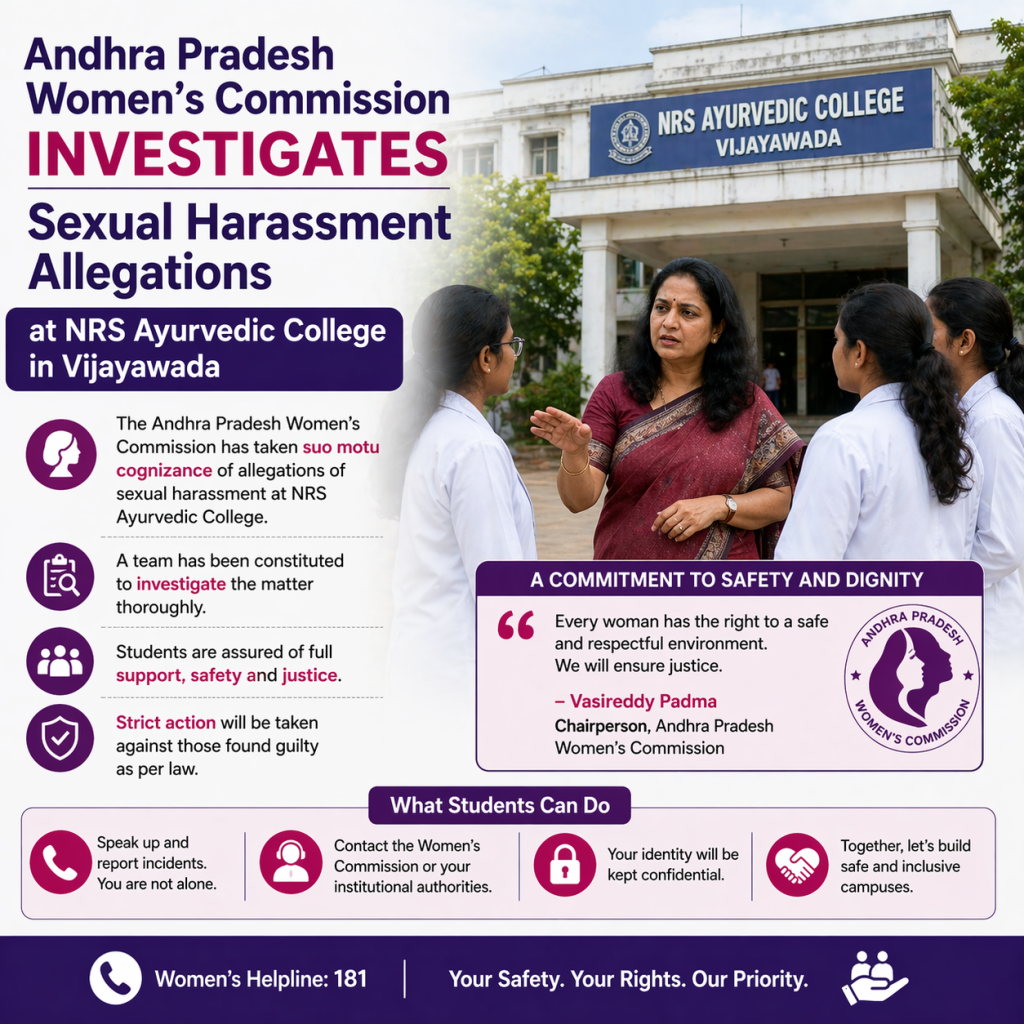
In recent days government Ayurvedic college in Vijayawada, Andhra Pradesh has come under scrutiny following reports of sexual harassment involving female students. Andhra Pradesh State Women’s Commission has stepped in conducting an on ground inspection and initiating a formal probe while the investigation is ongoing, case highlights broader concerns about student safety, institutional accountability, and the effectiveness of complaint mechanisms in professional education settings across India.
This isn’t just another headline, it raises important questions about how colleges handle sensitive complaints, what protections students actually have and what practical changes can prevent such issues in the future. Here’s a clear, factual look at the situation and the wider context that every student, parent and educator should understand.
What We Know About the Allegations at NRS Ayurvedic College
According to multiple reports including those from the Medical Dialogues Bureau and local media outlets like The Hindu and Deccan Chronicle, matter began with an anonymous email sent by a student to the Andhra Pradesh State Women’s Commission. Complaint alleged sexual harassment of female students by one or more faculty members at Dr. Nori Rama Sastry (NRS) Government Ayurvedic College.
Commission Chairperson Dr. Rayapati Sailaja responded promptly on Wednesday, she carried out a surprise inspection at the college. She held separate confidential meetings with students and faculty members to gather direct accounts. During these interactions, some students reportedly confirmed elements of the complaint but explained they had remained silent earlier due to fears of academic retaliation such as poor marks or failure in examinations.
College had previously conducted its own internal inquiry and dismissed the allegations as baseless. However, Commission identified several procedural shortcomings in that process. These details have been reported consistently across credible sources covering the story.
Key Lapses Identified in the College’s Response
One of the main issues flagged by the Women’s Commission was the handling by the college’s Internal Complaints Committee (ICC). Under Indian law, every educational institution is required to have a properly constituted ICC to deal with complaints of sexual harassment. In this case reports indicate the committee was formed more than a month after the initial complaint surfaced and did not include the mandatory external members, which compromises independence and transparency.
Students who tried to raise concerns allegedly faced pressure and intimidation. Commission noted inconsistencies between the college’s preliminary findings and information shared during the fresh inquiry. Importantly, inspection took place while the college principal was on leave, adding another layer to questions about oversight.
Dr. Sailaja has emphasized that the Commission takes these matters seriously and will base further action on the outcome of its detailed investigation. The focus she stated is on creating a safe academic environment where students can study without fear.
Why Cases Like This Matter in AYUSH and Medical Education
Sexual harassment in higher education institutions, particularly in professional courses like Ayurveda (under the AYUSH system), medicine and allied health fields, is not new. Students in these programs often live away from home, spend long hours in clinical or campus settings, and operate in hierarchical environments where faculty hold significant power over grades and future careers.
Government data and surveys from various states have shown that a notable percentage of female students in medical and technical colleges report experiencing some form of unwelcome behavior while exact figures vary, the pattern is consistent: power imbalances, fear of speaking up and sometimes inadequate institutional mechanisms allow issues to persist. In the case of NRS Ayurvedic College,a longstanding government institution offering BAMS (Bachelor of Ayurvedic Medicine and Surgery) programs this incident underscores that no institution is immune, regardless of its focus on holistic health and traditional values. Allegations, if proven, point to a gap between the institution’s mission and the day to day reality for some students.
Understanding Your Rights: The POSH Act and ICC Requirements
India has a clear legal framework to address this: The Sexual Harassment of Women at Workplace (Prevention, Prohibition and Redressal) Act, 2013 commonly known as the POSH Act. It applies to educational institutions as “workplaces.”
Key requirements include:
- Every institution must constitute an Internal Complaints Committee (ICC) with a presiding officer at least two faculty or staff members and crucially one external member from an NGO or similar body familiar with sexual harassment issues.
- Committee must complete inquiries within 90 days and recommend action to the management.
- Retaliation against complainants is strictly prohibited.
Many institutions struggle with compliance either delaying formation of the ICC or failing to make it truly independent. When that happens students lose confidence in the system, leading to under reporting. NRS case is a reminder that procedural compliance isn’t optional; it’s essential for trust.
Practical Steps for Students Facing Harassment
If you or someone you know is in a similar situation here are straightforward, actionable steps based on established guidelines from women’s commissions and legal experts:
- Document everything safely: Note dates, times, locations, what happened and any witnesses. Save emails, messages or other evidence without confronting the person directly if it feels unsafe.
- Reach out confidentially: Start with a trusted faculty member, college counselor or directly contact the ICC (even if you suspect it’s not functioning perfectly). You can also approach external bodies like the State Women’s Commission, National Commission for Women (NCW) or local police if needed. Anonymous complaints are often accepted initially.
- Know the helplines: In Andhra Pradesh and across India, use the National Commission for Women helpline (7827170170) or the 24x7 Women’s Helpline (1091). Many states also have dedicated student grievance portals.
- Seek support: Talk to family, friends, or campus mental health services. Harassment can affect concentration, mental health, and academic performance don’t hesitate to ask for extensions or counseling if required.
- Understand protections: The law requires institutions to protect your identity and prevent victimization. If you face retaliation, report it immediately as a separate issue.
Real life example: In several documented cases from other medical colleges, students who initially hesitated later found strength in group complaints or external support leading to meaningful institutional changes.
How Educational Institutions Can Build Safer Campuses
For college administrations, the lesson is clear. Prevention goes beyond forming a committee on paper. Practical measures include:
- Regular gender sensitization workshops for faculty and students.
- Clear, visible policies displayed on notice boards and websites.
- Anonymous feedback mechanisms and regular audits of the ICC.
- Swift, transparent action when complaints arise no delays, no cover ups.
- Leadership that models accountability, including principal and management oversight.
Institutions that treat these issues seriously often see higher student satisfaction and better overall reputation.
FAQ
Q1: Is the investigation at NRS Ayurvedic College still ongoing?
Yes. The Andhra Pradesh Women’s Commission has initiated a detailed probe following its inspection. No final conclusions have been announced yet, and further action will depend on the findings.
Q2: What is an Internal Complaints Committee (ICC)?
It’s a mandatory body under the POSH Act 2013 for handling sexual harassment complaints in workplaces and educational institutions. It must be independent and include external representation.
Q3: Can students file anonymous complaints?
Yes, many commissions and institutions accept anonymous or confidential complaints to encourage reporting without fear of identification.
Q4: What happens if a complaint is found to be true?
Depending on the severity, the institution can take disciplinary action, including suspension or termination of the accused. Legal proceedings may also follow if police are involved.
Q5: How can parents support their children in such situations?
Stay informed about college policies, encourage open communication, and know external resources. Teach children about consent and boundaries early on.
Moving Forward: A Call for Accountability and Awareness
The allegations at NRS Ayurvedic College serve as an important wake up call not just for this institution, but for every college aiming to provide quality education. True excellence in Ayurveda or any field requires an environment where every student feels respected and safe.
As the investigation proceeds, it’s crucial that all parties cooperate fully and that the process remains fair and transparent. Students deserve to focus on their studies without fear. Institutions must prioritize compliance with the law and foster a culture of respect. If you’re a student reading this, remember your voice matters. If you’re an educator or administrator, use this moment to review and strengthen your own systems. And if you’re a parent or concerned citizen, supporting stronger enforcement of existing laws helps create lasting change.
Safe campuses aren’t built overnight but consistent attention to these issues can make a real difference. Let’s hope the current investigation leads not only to justice in this case but to broader improvements across educational institutions in Andhra Pradesh and beyond.
Disclaimer
This post is for informational and educational purposes only. It does not constitute medical advice, legal opinion or an official investigation. Readers should consult qualified healthcare professionals for personal health concerns. All details are drawn from media reports and outcomes of any official inquiry may provide further clarity.
Link: According to media reports from The Hindu https://www.thehindu.com/news/national/andhra-pradesh/womens-panel-chief-flags-lapses-in-sexual-harassment-inquiry-at-ayurvedic-college/article70893953.ece/amp/