• 07 Mar, 2026

Medicaldrafts

ChatGPT Medical Advice Leads to Internal Bleeding: AIIMS Doctors Issue Strong Warning

ChatGPT Medical Advice Leads to Internal Bleeding: AIIMS Doctors Issue Strong Warning

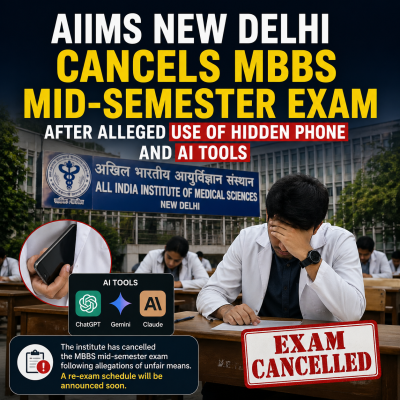
AIIMS New Delhi doctors have issued a serious warning against using AI tools like ChatGPT for medical diagnosis or treatment after a patient suffered severe internal bleeding by following chatbot generated advice for back pain. The case highlights the dangers of self medication, AI hallucinations, and why real medical consultation, tests, and clinical judgement cannot be replaced by algorithms.

IIT Indore Develops AI Powered Human Digital Twin for Early Disease Detection

IIT Indore Develops AI Powered Human Digital Twin for Early Disease Detection

IIT Indore has developed an AI powered human digital twin under the Charak DT Platform to help doctors simulate diseases and enable early and preventive diagnosis. This futuristic human like replica can mimic breathing and blinking and allows medical experiments to be tested digitally before real world treatment, marking a major leap in Indian healthcare technology.

Maharashtra University of Health Sciences (MUHS) Adopts Blockchain to Prevent Fake Certificates in Medical Education

Maharashtra University of Health Sciences (MUHS) Adopts Blockchain to Prevent Fake Certificates in Medical Education

Maharashtra University of Health Sciences (MUHS) has announced a blockchain based system to issue medical degrees, mark sheets and training records. The move aims to prevent fake certificates, ensure tamper proof verification and modernise medical education in India. Learn how blockchain will transform academic credential verification.

Exact Time of Death Cannot Be Determined by Rigor Mortis: Orissa High Court Ruling Explained

Exact Time of Death Cannot Be Determined by Rigor Mortis: Orissa High Court Ruling Explained

The Orissa High Court has clarified that the exact time of death cannot be determined using rigor mortis alone. This detailed medico legal analysis explains the limits of postmortem science, the role of rigor mortis, and why courts must not rely on false precision. An essential read for doctors, forensic experts, lawyers, and medical officers conducting postmortems.